Oman Electrical Standards (OES) are the technical standards for electrical work on Oman’s distribution network, from overhead lines and substations to the wiring inside a building. Any engineer, contractor or building owner planning a solar PV system, a new building or an EV charger in Oman will meet them. This guide explains what the OES series covers, what OES-4 requires for building installations, and how the standards apply to solar projects.
What Are the Oman Electrical Standards (OES)?
The OES series sets the requirements for equipment, materials and installation practice on the electricity distribution system. Nama Distribution publishes the current set on its website. The standards cover the whole chain, from medium-voltage lines down to the consumer’s installation.
OES Standards List
The standards published by Nama Distribution are grouped as follows:
| Standard | Subject |
|---|---|
| OES 1 | 33 kV and 11 kV overhead lines |
| OES 2 | Underground cable installation; cables and accessories |
| OES 3 | LT (low tension) overhead lines |
| OES 4 | Electrical installations in buildings (third edition) |
| OES 5, 5A and 6 | Transformers |
| OES 7, 21, 22, 23, 28 and 31 | LT equipment and material |
| OES 8, 9, 10, 16, 17, 18, 20, 25, 26, 29 and 33 | Overhead line material and equipment |
| OES 11 | General specifications for electrical equipment and materials |
| OES 12A, 12B, 13, 14, 15, 19, 34 and 35 | Switchgear and associated equipment |
| OES 24 | 33/11 kV indoor substations |
| OES 27 (Volume 1) | 132/33 kV substations |
| OES 30 | 33/11 kV outdoor substations |
| OES 32 | 132 kV overhead lines |
| OES 36 | Indoor substations |
| OES 37 | Dry type transformers |
For building owners and solar projects, the most important one is OES-4.
OES-4: Electrical Installations in Buildings
OES-4, the Regulations for Electrical Installations in the Sultanate of Oman, was issued as a third edition in May 2019 by the Authority for Electricity Regulation, now the Authority for Public Services Regulation (APSR). It took effect on 1 January 2020.
What OES-4 covers
OES-4 applies to fixed electrical installations in residential, commercial, public, industrial and agricultural buildings, as well as construction sites, temporary installations such as exhibitions, and mobile installations. It covers circuits up to 415/240 V AC, 50 Hz.
Main sections
- General rules, including design submission and inspection
- Fundamental principles: safety, protection, conductor sizing and testing
- Supply characteristics, voltage drop and labelling
- Selection of equipment
- Service connection and the consumer’s installation
- Conductors, cables, conduits, trunking and trays
- Earthing and earth leakage protection
- Accessories, lightning and overvoltage protection, standby generators
- Construction sites and agricultural installations
- Special installations, including solar PV systems and EV charging
- Testing and inspection, with forms and tables in the appendices
Key OES-4 requirements
- Supply: three-phase, four-wire, 415/240 V ±6%, 50 Hz.
- Earthing: the consumer installs a separate earthing system with an earth electrode, with a target resistance of 50 Ω or less. OES-4 notes that its earthing arrangement differs from IEC 60364 and BS 7671, so designs copied from other countries must be adapted.
- Earth leakage protection: residual current protection is required on circuits as set out in the standard.
- Qualified people: electrical work must be done by, or under the direct supervision of, a licensed electrician, and designs must come from a qualified engineer or licensed electrician.
- Approval before work: design documents are submitted to the distribution company and approved before work starts.
- Inspection before connection: the distribution company’s inspector checks the work, and supply is connected only after approval. Testing and certification follow the testing section of OES-4.
How OES Applies to Solar PV Projects
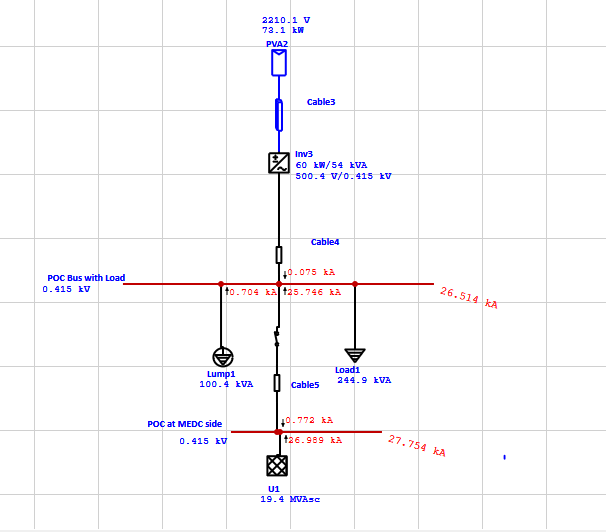
A grid-connected solar system is part of the building’s electrical installation, so OES-4 applies to its AC side, earthing, protection and testing, and the solar section of OES-4 applies on top. In practice this means:
- Designing the AC connection, protection and earthing to OES-4, not to a foreign code.
- Using DCRP-approved products and a DCRP-registered contractor. See DCRP and Nama approval.
- Sizing the system within Nama’s connection limits, including the 50% rule.
- Following the grid-connection technical guidelines. See our solar PV technical guidelines in Oman and solar PV technical requirements.
- Submitting the design to Nama, then passing inspection and testing before the system is connected.
Where to Get the OES Documents
The current OES documents, including OES-4, are published on the Nama Distribution OES page. Always check that you are using the latest edition before you design.
Frequently Asked Questions
What does OES stand for?
OES stands for Oman Electrical Standards, the technical standards for equipment and installations on Oman’s electricity distribution network.
What is OES-4?
OES-4 is the Regulations for Electrical Installations in the Sultanate of Oman. The third edition was issued in May 2019 and took effect on 1 January 2020. It covers wiring, protection, earthing, special installations such as solar PV and EV charging, and testing and inspection.
Does OES-4 apply to solar PV systems?
Yes. OES-4 has a section on solar PV systems, and its general rules on earthing, protection, testing and inspection apply to the AC side of any grid-connected system.
Is OES-4 the same as BS 7671 or IEC 60364?
No. OES-4 draws on international practice, but its earthing arrangement differs from IEC 60364 and BS 7671. Designs must follow OES-4 for installations in Oman.
Who checks that an installation meets OES?
The distribution company reviews the design before work starts and its inspector checks the installation before the supply is connected.
Need an OES-Compliant Solar Design?
AL-DHAW is DCRP S2 certified and designs solar systems to Oman’s electrical standards, from the single-line diagram to Nama inspection and connection. Contact our engineers or explore our solar consultancy services.