
Last updated: 27 September 2026
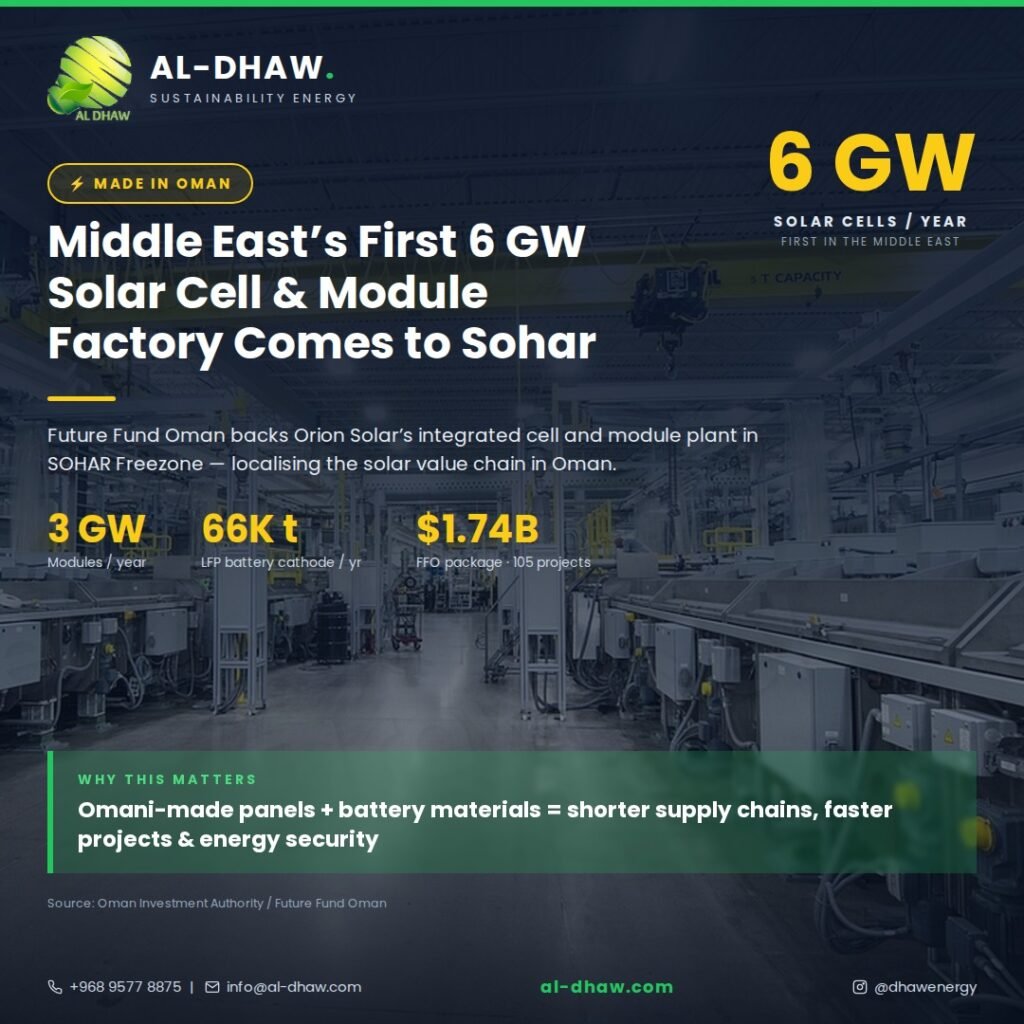
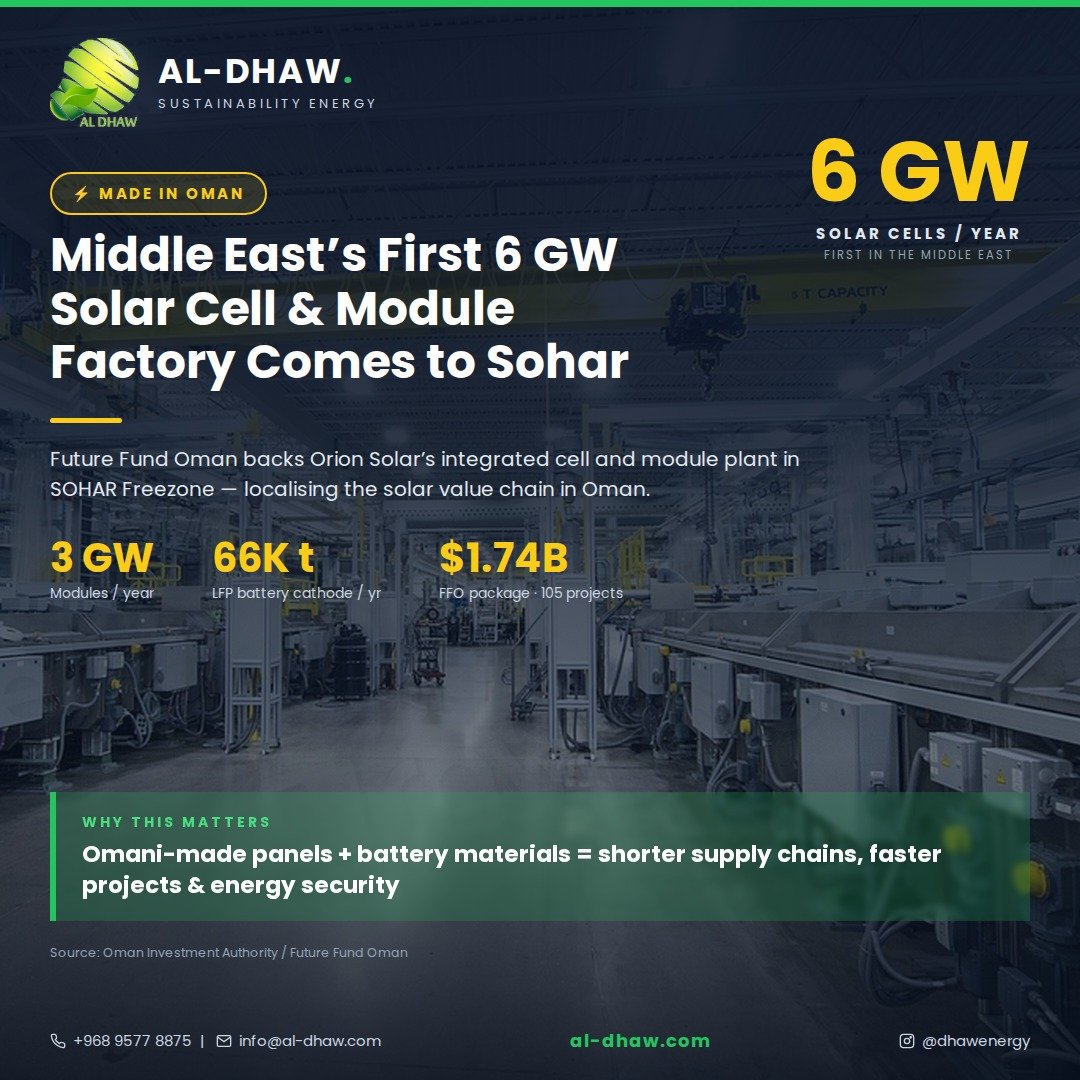
Solar panel manufacturing in Oman is about to reach a new scale. Future Fund Oman (FFO), part of the Oman Investment Authority (OIA), has selected Orion Solar to build an integrated solar cell and module factory in SOHAR Freezone. The plant is planned at 6 GW of solar cells and 3 GW of modules per year. The OIA describes it as the first facility of its kind in the Middle East and a cornerstone for localising the solar value chain.
What Was Announced: A 6 GW Solar Factory in Sohar
On 16 July 2026, FFO unveiled a package of 105 strategic projects worth US$1.744 billion. FFO commits about US$585 million, while local investors add roughly US$458 million. The package covers renewable energy, manufacturing, tourism, healthcare, technology and food security.
Orion Solar is the flagship project. Local reports say the factory is backed by Chinese investors and could cost around OMR 220 million. Further details, such as the cell technology and construction timeline, have not yet been released.
- Location: SOHAR Port and Freezone, North Al Batinah
- Solar cell capacity: 6 GW per year
- Module capacity: 3 GW per year
- Backer: Future Fund Oman (Oman Investment Authority)
Key Fact: Orion Solar is billed as the Middle East’s first integrated solar cell and module manufacturing facility.
Building Oman’s Full Solar Value Chain
The new factory does not stand alone. Sohar is already home to United Solar’s polysilicon plant. It targets 100,000 tonnes of polysilicon per year, enough for about 40 GW of modules, and is the largest of its kind outside China. United Solar completed its US$1.6 billion funding in July 2026. You can read more in our article on United Solar’s polysilicon project in Oman.
Together, these projects create a local chain from raw material to finished product:
- Polysilicon (United Solar, Sohar)
- Solar cells (Orion Solar, Sohar)
- Solar modules (Orion Solar, Sohar)
- Battery materials (Gallant Industrial Project)
Energy Storage: 66,000 Tonnes of LFP Cathode Material
The same FFO package includes the Gallant Industrial Project. It will produce about 66,000 tonnes per year of lithium iron phosphate (LFP) cathode material. LFP is the battery chemistry that now dominates grid-scale battery energy storage systems (BESS), and it is also used in electric vehicles.
This matters because Oman’s grid is adding storage fast. Nama PWP has said it targets around 7 GW of solar, 3 GW of wind and 3 GW of storage by 2030. Local battery materials could support that pipeline and reduce reliance on imports.
What Local Solar Panel Manufacturing Means for Oman
Shorter Supply Chains
Most solar modules installed in the GCC today are shipped from Asia. A factory in Sohar could cut lead times and reduce exposure to shipping disruptions and freight costs.
Higher In-Country Value
Utility-scale IPPs and industrial projects increasingly reward local content. Omani-made cells and modules can raise In-Country Value (ICV) for developers and EPC contractors.
Skilled Jobs and Economic Diversification
Advanced manufacturing creates technical jobs in engineering, quality control and operations. It also supports Oman Vision 2040 goals to grow non-oil industries and reach 30% renewables in the power mix by 2030.
AL DHAW’s View
At AL DHAW Sustainability Energy, we see local solar manufacturing as a key step for the whole market. Faster supply and stronger local content will help utility projects, businesses and homes alike. Panel choice still matters in our climate, so read our guide on أداء الألواح الشمسية في الحرارة العُمانية. If you are planning a system for your business, see our overview of commercial solar in Oman or talk to our solar consultancy team.
الأسئلة الشائعة
Are solar panels manufactured in Oman?
Oman is building a local solar supply chain. United Solar’s polysilicon plant already operates in Sohar, and Future Fund Oman has backed Orion Solar’s planned 6 GW solar cell and 3 GW module factory in SOHAR Freezone. Timelines for module production have not yet been announced.
What is Orion Solar in Oman?
Orion Solar is the company selected by Future Fund Oman to build an integrated solar cell and module manufacturing plant in SOHAR Freezone. It is the flagship of a US$1.744 billion FFO investment package announced in July 2026, and the OIA calls it the first facility of its kind in the Middle East.
What is Future Fund Oman?
Future Fund Oman is a US$5.2 billion investment vehicle managed by the Oman Investment Authority. Established in 2024, it co-invests with local and international partners in priority sectors to attract foreign investment and diversify the economy under Oman Vision 2040.
Will local manufacturing lower solar prices in Oman?
It is too early to say. Local production can reduce shipping costs and lead times, but final prices depend on global module markets, factory output and technology. The clearer benefits today are supply security and higher local content for projects.
Conclusion
The Orion Solar project moves solar panel manufacturing in Oman from ambition to plan. With polysilicon, cells, modules and battery materials all taking shape in Sohar, the Sultanate is becoming a solar producer, not only a buyer. Follow our Oman renewable energy news for updates, or contact AL DHAW to plan your own solar project.
Sources: pv magazine; PV Tech; Oman Observer; pv magazine (Nama PWP targets).

 العربية
  English